








Schedule a Call Back


India’s Shell Body Advantage: Forging the Future of Global Defence Supply
 Articles
- Sep 28,26
Col Sandeep Rao, Advisor, Tirupati Forge Ltd, examines India’s emerging role in shell body manufacturing and how expanded forging capacity could reshape global ammunition supply chains.

The 2020s are witnessing an unexpected reversal in military doctrine. Traditional artillery has roared back to the centre of strategic doctrine after decades of emphasis on drone warfare and air superiority. The Russia-Ukraine conflict and Nagorno-Karabakh war have exposed critical vulnerabilities in global supply chains. The global artillery ammunition market, valued at $6.81 billion in 2026 and projected to reach $8.46 billion by 2035, masks an acute regional supply crisis. Global demand has increased 42 per cent, yet capacity remains the binding constraint. Artillery remains the king of the battlefield.
As NATO nations scramble to replenish stockpiles, a critical bottleneck has emerged: global shell body manufacturing capacity. Manufacturing constraints currently affect 36 per cent of global ammunition producers. This is where India, with proven manufacturing competence, certified facilities, and strategic positioning as a non-aligned partner, can play a transformative role. Unlike filled ammunition, empty shell bodies face fewer export restrictions. Europe holds 39 per cent of the global artillery ammunition market share but critically lacks forging capacity. This infrastructure mismatch creates India’s opportunity.
The Russia-Ukraine war has been defined by artillery. Assessments indicate that artillery accounts for 50–70 per cent of casualties on both sides, with 155mm NATO-standard systems driving operational intensity. Seventy-two per cent of armies worldwide now operate large-calibre systems exceeding 105mm, with 68 per cent of global ammunition demand driven by fighting applications. By mid-2023, Ukrainian forces were consuming approximately 200,000 155mm shells per month, driven by high-intensity operations and the need to sustain defensive positions against a numerically superior Russian force.
NATO’s response exposed structural vulnerability. Allied nations could only produce roughly 85,000–100,000 155mm shells monthly by late 2023. The gap of approximately 100,000–115,000 shells per month revealed Western supply chains built for peacetime, not industrial-scale conflict. The US allocated $1 billion to Scranton. Germany doubled Rheinmetall’s capacity. France ramped Nexter KNDS, yet even at maximum stretch, global output barely matched demand. Industry improvements achieved 41 per cent capacity gains through automation, but this came after critical shortages. In peer conflict, raw shell-body production capacity, not air dominance or technological edge, becomes the binding constraint on military operations.
Today’s global 155mm shell body manufacturing capacity stands at approximately 21,000 tonnes per annum. NATO nations account for 60 per cent, creating strategic dependency. The United States leads at 4,500 tpa (15 per cent), followed by Germany’s Rheinmetall at 3,200 tpa (14 per cent), France’s Nexter at 2,800 tpa (13 per cent), and the UK’s BAE Systems at 2,100 tpa (10 per cent). Israel adds 1,800 tpa, while Poland, Czech Republic, and South Korea collectively produce 2,300 tpa. The two leading suppliers control 29 per cent of global supply. Any single-nation disruption creates cascading shortages across the alliance.
What stands out is India’s extraordinary position and its systematic underutilisation. India’s 4,300 tpa capacity represents 20.5 per cent of global supply, rivalling France and exceeding the UK. Yet this capacity has never been systematically leveraged for allied supply. India, positioned outside NATO but strategically aligned with the West, holds the key.
Empty shell bodies and filled ammunition follow entirely different regulatory pathways. Filled ammunition falls under stringent MTCR restrictions, with transit times measured in weeks and prohibitively high insurance costs. Empty shell bodies, classified as industrial forgings, face minimal MTCR restrictions and move through standard shipping channels. A 155mm shell body can be air-freighted to Europe in 48–72 hours without explosive materials clearance, then filled by European energetics suppliers or contracted facilities. This distinction unlocks a strategic advantage overlooked for decades.
European nations — Poland, Germany, France, and Czech Republic — possess established filling capacity. Market research confirms they supply 78 per cent of regional demand through domestic production, yet critically lack closed-die forging capacity for shell bodies. Indian shell bodies enable European filling plants to operate at full capacity, transforming what appears to be a bottleneck into a distributed, resilient system.
India’s manufacturing roadmap is ambitious: expanding from 9,700 tpa of large-calibre capacity in 2024 to 15,200–17,300 tpa by 2028, a 55–78 per cent increase. Tier-1 private forgers commit to an additional 1,650 tpa. Emerging manufacturers — Tirupati Forge Limited, Goodluck, Nibe Industries, and Sunita Tools — collectively target 3,000–4,500 tpa by 2028. DPSU plants target approximately 200 tpa of additional capacity. If India maintains 70 per cent domestic allocation and expands to 16,000 tpa by 2028, approximately 4,800 tpa becomes available for export, a sixteen-fold increase. That is transformative.
Among emerging manufacturers, Tirupati Forge Limited exemplifies the pathway to rapid scale and export readiness. Current pilot capacity stands at 450 tpa; the production ramp targets 1,500 tpa by 2028. Tirupati’s competitive advantage lies in its history of high-quality forgings combined with modern closed-die forging infrastructure. Automation adoption has reduced defect rates to below 1.8 per cent per 10,000 rounds; Tirupati’s modern technology meets these standards. Shell bodies can be marketed directly to European ammunition filling contractors, Polish manufacturers like Mesko, and NATO procurement channels without Ministry mediation.
Sixty-three per cent of the global market is large-calibre ammunition. Tirupati’s vision to build on existing capacity and develop other variants of 155mm shells will serve the high-value segment of extended-range shells.
Instead of channelling all exports through a single government entity or complex protocols, Tirupati and parallel emerging players create a distributed, market-responsive export ecosystem. Each can pursue independent OEM partnerships, negotiate bilateral contracts with EU nations, and compete directly on price, quality, and delivery speed.
Distributed manufacturing across the US, EU, India, and allied suppliers creates structural redundancy. If one region experiences disruption, orders redirect to alternate sources without cascading shortages. India as a third source transforms shell body manufacturing from a NATO-centric bottleneck into a resilient, multi-polar network. Emergency orders can be redirected to Indian manufacturers within 48–72 hours via air freight.
Strategic reserves mandate 30–90 days of coverage globally, translating into multi-million-unit procurement cycles annually. India’s expanded capacity directly addresses this structural demand.
In an era of great power competition and contested supply chains, India’s emerging shell body ecosystem is positioned to own a significant share of the global ammunition market, valued at USD 8.46 billion by 2035. The battle for future conflicts is being fought in factories. India has positioned itself to own a significant slice of this market.
About the author:
Col Sandeep Rao (Retd) is a veteran Indian Army Artillery officer with over two decades of service spanning frontline combat operations, counter-terrorism, and high-altitude command along the Line of Control.
Tirupati Forge
Col Sandeep Rao
shell body manufacturing
artillery ammunition
defence manufacturing
closed-die forging
large-calibre ammunition
India defence industry
ammunition supply chain
Related Stories
Aerospace Defence
India’s Shell Body Advantage: Forging the Future of Global Defence Supply
Col Sandeep Rao, Advisor, Tirupati Forge Ltd, examines India’s emerging role in shell body manufacturing and how expanded forging capacity could reshape global ammunition supply chains.
Read moreSmart Manufacturing
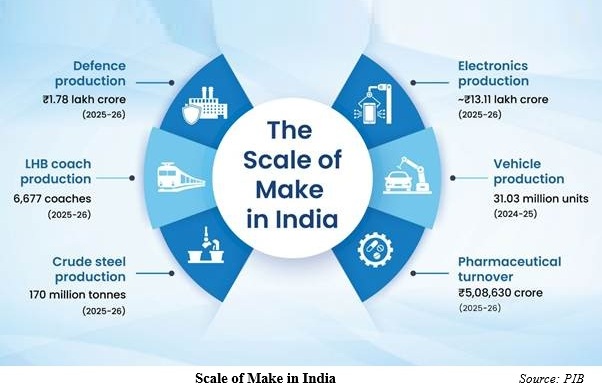
12 Years of Make in India: A look at India’s manufacturing progress
Over the past 12 years, India has expanded manufacturing across key sectors, with the next phase hinging on stronger domestic value addition and increasing global competitiveness.
Read moreAerospace Defence

JCBL Group receives DRDO technology transfer for 20T Heavy Drop System
JCBL Group has received technology-transfer rights from DRDO for the 20T Heavy Drop System for C-130 and C-17 aircraft, strengthening indigenous defence manufacturing capabilities.
Read moreRelated Products
Troop Comforts revolutionises military gear with indigenous innovations
Aerospace & Defence
Troop Comforts Ltd (TCL), a state-owned defence corporation, has recently received a request for proposal (RFP) from the Northern Command of the Indian Army for its indigenously developed military gea Read more
latest News
Subscribe to iNoW

For Industry News on WhatsApp, Give a Miss Call on: +91 84228 74016