







Schedule a Call Back


12 Years of Make in India: A look at India’s manufacturing progress
 Articles
- Sep 28,26
Over the past 12 years, India has expanded manufacturing across key sectors, with the next phase hinging on stronger domestic value addition and increasing global competitiveness.
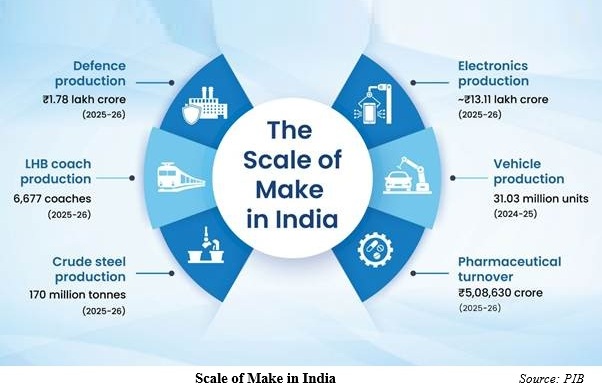
Twelve years after its launch, Make in India has expanded India's manufacturing capacity across electronics, automobiles, pharmaceuticals, steel, railways, defence and several emerging technology sectors, while new government programmes are increasingly focused on components, strategic materials and advanced manufacturing.
Launched on September 25, 2014, Make in India was designed to establish India as a global hub for manufacturing, design and innovation by facilitating investment, promoting innovation and developing infrastructure. It has since expanded into Make in India 2.0, covering 27 sectors, including 15 manufacturing and 12 services sectors.
Manufacturing Gross Value Added (GVA) at constant prices recorded a compound annual growth rate of 10.88 per cent between 2022-23 and 2025-26 under the revised national accounts series. Manufacturing output under the Index of Industrial Production increased 7.0 per cent during April-July 2026 compared with the corresponding period in 2025.
Electronics and automobiles expand production
Electronics has emerged as one of the fastest-growing areas. Electronics production increased nearly sevenfold from around Rs 1.9 lakh crore in 2014-15 to about Rs 13.11 lakh crore in 2025-26. Mobile-phone production increased approximately 32 times, from around Rs 18,900 crore to about Rs 6.3 lakh crore over the same period.
India is now the world's second-largest mobile-phone manufacturer by volume, while total electronics production grew 15.8 per cent during 2025-26 compared with the previous year.
Vehicle manufacturing has also increased. India produced 31.03 million vehicles during 2024-25, about 33 per cent higher than in 2014-15.
Compared with 2020-21 levels, passenger-vehicle and commercial-vehicle production increased by 65 per cent each during 2024-25. Three-wheeler production rose 71 per cent, while two-wheeler production increased 30 per cent.
Pharmaceuticals, steel and defence strengthen capacity
India's pharmaceutical industry ranks third globally by volume and 11th by value. Annual pharmaceutical turnover reached Rs 508,630 crore in 2025-26, recording average growth of 9.2 per cent over the preceding five years.
Pharmaceutical exports during 2025-26 stood at Rs 262,697 crore. Meanwhile, domestic medical-device manufacturing increased approximately 48.2 per cent from around Rs 28,000 crore in 2019-20 to Rs 41,500 crore in 2024-25.
Steel production has almost doubled over the Make in India period. Crude-steel output increased from 81.7 million tonnes in 2014-15 to 170 million tonnes during 2025-26.
Defence manufacturing recorded another significant increase. Indigenous defence production rose from Rs 46,429 crore in 2014-15 to a record Rs 1.78 lakh crore in FY2025-26, representing an increase of approximately 283 per cent.
Railways scales domestic production
Indian Railways manufactured 54,809 coaches between 2014 and 2024. Average annual coach production increased from less than 3,300 during 2004-14 to 5,481 during 2014-24. During 2025-26, Indian Railways produced 1,674 locomotives and manufactured 6,677 Linke Hofmann Busch coaches.
Production of critical railway components has also increased. In 2025-26, the Rail Wheel Factory produced 2,10,026 wheels, 1,22,000 axles and 1,20,100 wheelsets, registering growth of 4 per cent, 30 per cent and 22 per cent, respectively, over the previous year.
Manufacturing moves into advanced technologies
India's manufacturing expansion is increasingly extending beyond finished products into advanced components, specialised materials, machinery and technology.
In pharmaceuticals, the country now manufactures complex products including Trastuzumab Emtansine, described as the world's first biosimilar antibody-drug conjugate for breast cancer, and Docaravimab-Miromavimab, an anti-rabies monoclonal antibody combination. Miqnaf is India's first developed macrolide antibiotic in three decades for bacterial pneumonia, while Desidustat represents a new chemical entity developed for treating anaemia in kidney patients.
Strategic materials are another focus. A pilot facility for Neodymium-Iron-Boron rare-earth permanent magnets was established at the International Advanced Research Centre for Powder Metallurgy and New Materials in Hyderabad in March 2026. Such magnets are important for electric vehicles, renewable-energy systems, electronics and advanced manufacturing.
Semiconductors, solar and EV systems gain ground
Domestic capability is also expanding across semiconductor, solar, electric-vehicle and aerospace technologies. ISRO and Semiconductor Laboratory developed the VIKRAM3201 and KALPANA3201 microprocessors for space applications. VIKRAM3201 is the first fully Make-in-India microprocessor qualified for launch-vehicle conditions, while KALPANA3201 has been designed to work with open-source software tools.
Solar-module manufacturing capacity increased sharply from 2.3 GW in 2014 to 192 GW by June 2026. Solar-cell manufacturing capacity rose from 1.2 GW to around 30 GW over the same period. An indigenous 30 kW electric-vehicle drive system integrating the motor and inverter was launched in March 2026 after being designed, fabricated and validated domestically.
In aerospace, Hindustan Aeronautics Limited opened its third Light Combat Aircraft Tejas Mk1A production assembly line in October 2025, increasing annual production capacity to 24 aircraft. HAL also inaugurated a second HTT-40 trainer-aircraft production line.
Capital goods production nearly doubles
Growth in manufacturing has also increased demand for domestically produced machinery. Production across heavy engineering equipment and capital-goods sub-sectors increased from Rs 2,87,233 crore in 2019-20 to Rs 5,69,900 crore in 2024-25, representing nearly a twofold increase.
Investment facilitation and industrial infrastructure programmes have supported this expansion. India permits 100 per cent Foreign Direct Investment through the automatic route across most sectors except certain strategic industries. Cumulative FDI reached $843 billion between 2014-15 and 2025-26, an increase of 169 per cent compared with the preceding 12-year period.
Table 1: Production across Various Capital Goods Sectors & Heavy Engineering Equipment (value in Rs crore)

Digital platforms support industrial investment
The National Single Window System provides businesses access to more than 327 Central approvals and 3,452 State approvals across 34 States and Union Territories.
As of September 21, 2026, the platform was handling an average of more than 3.06 lakh applications annually and had onboarded over 5.69 lakh business entities. The India Industrial Land Bank, meanwhile, had mapped 4,220 industrial parks spanning approximately 6.98 lakh hectares as of May 2026.
PM GatiShakti National Master Plan is being used to coordinate infrastructure planning using geospatial data, satellite imagery and API integration. As of August 11, 2026, its Network Planning Group had evaluated 396 projects valued at approximately Rs 18.66 lakh crore. Of these, 256 had been sanctioned, including 198 projects under implementation.
PLI attracts Rs 2.6 lakh crore investment
Production Linked Incentive schemes now cover 14 sectors, including electronics, pharmaceuticals, automobiles, solar photovoltaic modules, specialty steel and textiles. As of June 2026, PLI schemes had attracted investment of Rs 2.6 lakh crore and generated Rs 23.8 lakh crore in production and sales. They had also supported exports exceeding Rs 15.5 lakh crore and created 14.6 lakh jobs. Startup India has complemented the manufacturing and innovation ecosystem. As of September 2026, around 2.54 lakh entities had been recognised as startups under the programme.
 New schemes target strategic manufacturingSeveral programmes introduced since late 2025 aim to deepen India's domestic manufacturing value chain.
- The third round of the Production Linked Incentive Scheme for Specialty Steel, launched in November 2025, covers advanced categories such as super alloys, CRGO steel, stainless steel products, titanium alloys and coated steels.
- A Rs 7,280 crore programme notified in December 2025 aims to establish 6,000 MTPA of integrated manufacturing capacity for sintered NdFeB rare-earth permanent magnets.
- The Bharat Audyogik Vikas Yojana, approved in March 2026 with an allocation of Rs 33,660 crore, targets development of 100 investment-ready industrial parks.
- The Mobile Phone Manufacturing Scheme, approved in July 2026, has been allocated Rs 62,500 crore for FY2026-27 to FY2030-31 to expand production, increase domestic value addition and strengthen supply chains.
- Semicon 2.0, also approved in July 2026, has received an allocation of Rs 1,27,500 crore for semiconductor design, manufacturing, advanced packaging, materials, equipment, research and talent development.
- Separately, Rs 3,030 crore has been allocated under BHAVYA Rasayan to facilitate the development of three dedicated chemical parks in India.
After 12 years, the Make in India programme has evolved from increasing domestic production towards developing deeper capabilities across materials, components, machinery and advanced technologies. The next phase of India's manufacturing expansion will increasingly depend on how these investments translate into domestic value addition, technology capabilities and globally competitive production.(Source: PIB)
Make in India
Indian manufacturing
electronics manufacturing
PLI scheme
semiconductors
automobile industry
pharmaceuticals
defence manufacturing
PM GatiShakti
industrial infrastructure
Related Stories
Aerospace Defence

India’s Shell Body Advantage: Forging the Future of Global Defence Supply
Col Sandeep Rao, Advisor, Tirupati Forge Ltd, examines India’s emerging role in shell body manufacturing and how expanded forging capacity could reshape global ammunition supply chains.
Read moreSmart Manufacturing
12 Years of Make in India: A look at India’s manufacturing progress
Over the past 12 years, India has expanded manufacturing across key sectors, with the next phase hinging on stronger domestic value addition and increasing global competitiveness.
Read moreElectrical & Electronics
From Modules to Materials: India’s Roadmap for Solar Manufacturing Leadership
India’s solar manufacturing journey is entering a new phase, driven by policy initiatives, domestic demand and global opportunities. The NITI Aayog report outlines the roadmap to build a resilient..
Read moreRelated Products

Fanless Industrial Pc for Smart Manufacturing
Smart Manufacturing
CONTEC Launches BX-M4600 Series - Fanless Industrial PC for Smart Manufacturing.
latest News
Subscribe to iNoW

For Industry News on WhatsApp, Give a Miss Call on: +91 84228 74016