


Schedule a Call Back


12 Years of Make in India: The Unfinished Agenda
 Case Studies
- Oct 29,26
Twelve years on, India is manufacturing more. But is it creating enough of its own technology? Industry leaders examine the gains, gaps and next big test for Make in India, writes Ashlin Rajan
Twelve years after its launch, Make in India has expanded production, attracted investment and strengthened capabilities across several industries. But has India built a manufacturing economy that can design its own technologies, compete globally and enable smaller enterprises to grow? Industry leaders examine the progress, contradictions and unfinished agenda.
A bigger manufacturing economy—but how much stronger?
Make in India aimed to make the country a global manufacturing, design and innovation hub. It sought to attract investment while improving infrastructure, the business environment and domestic industrial capabilities.
India’s manufacturing landscape has changed. Production has grown in electronics, automobiles, pharmaceuticals, steel, defence and capital goods. Domestic companies have moved into more sophisticated segments, and international businesses increasingly see India as a manufacturing and engineering destination.
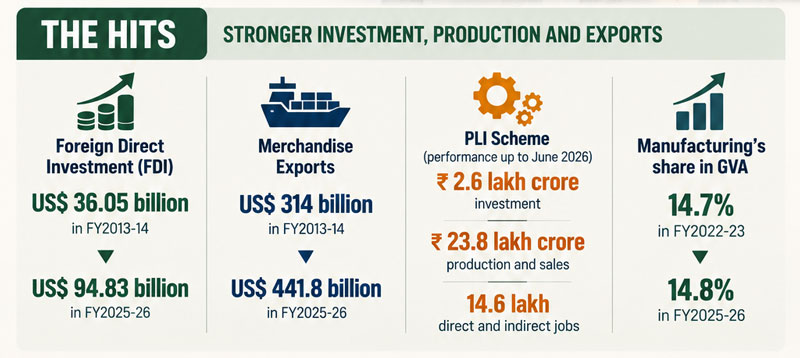
Yet growth in output has not substantially changed manufacturing’s share of the economy. According to the Ministry of Statistics and Programme Implementation, manufacturing accounted for 14.8 per cent of India’s gross value added (GVA) in FY2025–26, compared with 14.7 per cent in FY2022–23 under the revised national accounts series. Manufacturing GVA grew at a compound annual rate of 10.88 per cent over that period, while its share of GVA remained broadly unchanged.
This does not mean manufacturing has stagnated. It points to a difference between producing more and building deeper industrial capabilities. A stronger manufacturing economy must develop technology, retain more value domestically and create productive employment—not simply increase output.
The experiences of machine tool manufacturers, forging companies, industrial consultants and automation specialists reflect both the progress and the unfinished work.

Investment has expanded; execution remains the test
Make in India’s most visible achievement has been the expansion of investment and production capacity. Reforms covering foreign investment, industrial infrastructure, business approvals and manufacturing incentives have strengthened India’s investment proposition. The initiative has also broadened: Make in India 2.0 covers 27 sectors, including 15 manufacturing and 12 services sectors.
Acording to Shardul Fadnavis, Partner and Leader – Industrial Development and Investment Promotion at PwC India, “The gains are substantial but uneven, Make in India has expanded India’s industrial scale, strengthened its investment proposition and created globally competitive capabilities in selected sectors.”
Fadnavis points to investment reaching more technology-intensive industries, including automobiles, pharmaceuticals, electronics and renewable energy. Production-linked incentive (PLI) schemes across 14 sectors have reinforced this shift by linking incentives to incremental production and sales.
But investment announcements and production figures do not, on their own, demonstrate lasting industrial strength. The test is whether new facilities develop competitive domestic suppliers, build technological capabilities and produce goods that can succeed internationally without continued on incentives.
Fadnavis says delayed approvals, regulatory costs, logistics challenges and uneven state-level implementation can slow investments. Despite improvements in digital approvals and infrastructure planning, manufacturers still face difficulties securing land, infrastructure and skilled workers to begin production.
The next step: from assembly to value creation
The distinction between manufacturing scale and industrial depth is particularly visible in sectors where assembly has expanded faster than domestic component ecosystems. Electronics is one example. India’s manufacturing capabilities have grown with domestic demand, investment and government incentives. However, Fadnavis notes that significant dependence remains on imported intermediate goods, advanced machinery and proprietary technology.
Assembly can create jobs, build production experience and help companies enter global supply chains. The challenge is to use that foothold to develop product engineering, research and development, precision components, industrial equipment and domestic suppliers.

“India has built manufacturing scale faster than manufacturing depth. The priority now is to convert higher output into greater domestic value addition, productive employment and technology ownership,” says Fadnavis. That shift also calls for a broader measure of success.
Machine tools and forging reveal the capability gap
The machine tool and forging industries sit beneath a wide range of manufacturing sectors. Their progress, and their dependence on imported technology, offers a clear view of the strengths and gaps in India’s industrial base.
Jibak Dasgupta, Director General and CEO of the Indian Machine Tool Manufacturers’ Association (IMTMA), points to broader product portfolios and stronger production capabilities.
“Domestic machine tool makers are also seeing demand from aerospace, defence, electronics, semiconductors, railways and renewable energy, beyond their traditional reliance on the automotive sector. But advanced equipment remains a weakness. India has not yet become a machine-building economy,” he observes.
India needs sustained investment in indigenous technology, testing and certification facilities, collaboration between machine builders and end users, research funding and affordable long-term capital.

The forging industry shows a related, though distinct, advance. Yash J Munot, President of the Association of Indian Forging Industry (AIFI), said “Companies have strengthened their engineering, quality and process-control capabilities. Some have moved beyond build-to-print work, bringing machining, heat treatment and assembly in-house and supplying finished components rather than basic forgings.”
Yet progress remains uneven, with stagnant capacity utilisation, slow technology adoption among smaller manufacturers and dependence on imported high-capacity forging presses. Rising steel and electricity costs, skills shortages and cheaper imports add further pressure.
Smaller manufacturers find it harder to fund machinery, simulation and research while managing day-to-day costs. Together, these industries underline a central challenge for Make in India: expanding finished-goods production will not be enough without stronger domestic machinery and engineering capabilities.

SMEs: The Missing Middle
MSMEs supply components, provide specialised processes and support large manufacturers across industrial clusters. Their ability to grow and compete is therefore central to India’s wider manufacturing ambitions.
R Srinivasan, Director of AIRA Consulting Private Limited, said access to finance has improved. Banks and non-banking financial companies increasingly use GST records, cash-flow information and digital financial data to assess borrowers, reducing reliance on physical collateral. Government procurement platforms and credit-guarantee mechanisms have also created opportunities.
But he questions whether SMEs have benefited in proportion to the scale of the policy effort.
“Make in India has benefited SMEs, but not to the extent expected.” he stated. Investment promotion often favours large projects, whose headline figures attract attention. Srinivasan argues that multiple smaller investments can also generate jobs, strengthen local supply chains and support regional industry, even if their contribution is less visible.
Land is a major constraint. Industrial areas around Mumbai face pressure from residential and commercial development. For smaller manufacturers, land near customers and suppliers can be prohibitively expensive. Relocating farther away may lower property costs but make it harder to recruit workers.
The talent pipeline is also weakening. Manufacturers face shortages of skilled technicians, supervisors and engineering professionals needed to operate machinery, maintain quality standards and improve productivity.
SMEs also need a route from being lower-tier suppliers to taking on product development and higher-value work. The measure of progress should be not only how many SMEs enter supply chains, but also whether they can advance within them.
Advanced manufacturing needs people as well as plants
Semiconductors and advanced industrial equipment are among the next tests of Make in India. India has strengthened capabilities in several sectors, but developing indigenous technologies, equipment and specialised skills remains essential to moving up the global value chain.
Kishen Kavikondala, CEO of ATS India, sees progress in areas such as defence and space, where sustained government attention has helped build domestic capabilities. He believes that focus could offer lessons for the semiconductor ecosystem.
However, India still depends considerably on imported semiconductor manufacturing equipment. “But over the next five to ten years, I think that reliance will come down with the industry's Semicon 2.0 focus.”
He identifies workforce readiness as an immediate challenge, “Currently, the skill sets in India required for the country's ambition are lacking.” The Semicon 2.0 framework, while stressing that delivery matters more than announcements, “It's one thing to put something on a piece of paper, but it's a totally different thing to walk the talk.”
Reliable infrastructure, sustained government support and incentives accessible to manufacturers of different sizes will help determine whether India can develop the equipment and engineering capabilities that serve the sector. With global demand driven by artificial intelligence, data centres and other technology-intensive industries, the opportunity is significant—but competing economies are pursuing it too.
“The demand is there. If the passion and determination are there, it is totally possible,” he says.
The road to 2035: build capability, not just capacity
The next phase of Make in India must convert the expansion of production into enduring industrial strength. It must prioritise domestic value addition, technology ownership, research and development, and stronger supplier ecosystems. Investment in indigenous machinery, critical components, testing infrastructure, automation, digitalisation, workforce development and international technology partnerships will be essential to strengthening India's manufacturing capabilities.
For Srinivasan, smaller Indian businesses must be able to participate more fully in that growth, “Make in India must enable ‘Make in India by Indians’,” he says. India's manufacturing ambitions must extend beyond assembling finished products to developing the technologies, components and equipment behind them. According to government data, capital goods and heavy engineering production nearly doubled to Rs 5,69,900 crore in FY2024-25 from Rs 2,87,233 crore in FY2019-20. Greater domestic value creation will require India to strengthen its design, engineering, research and advanced manufacturing capabilities, enabling local enterprises to retain more value within the country's industrial supply chains.
Foreign investment and collaboration remain valuable sources of capital, technology and market access. The task is to ensure that Indian companies also build their own expertise, intellectual property and global competitiveness.
Twelve years on, Make in India has helped expand industrial scale. Its next measure of success will be whether that scale creates deeper domestic capabilities—and whether businesses of every size can contribute to them.
Make in India
Indian Manufacturing
Make in India 2026
Manufacturing Growth
Industrial Development
MSMEs
SME Manufacturing
Domestic Value Addition
Technology Independence
Semiconductor Manufacturing
Machine Tools
Forging Industry
Industrial Automation
PLI Schemes
Atmanirbhar Bharat
Shardul Fadnavis
Jibak Dasgupta
Yash J Munot
Kishen Kavikondala
R Srinivasan
PwC India
IMTMA
AIFI
AIRA
ATS India
Ashlin Rajan
Related Stories
Machine Tools & Accessories
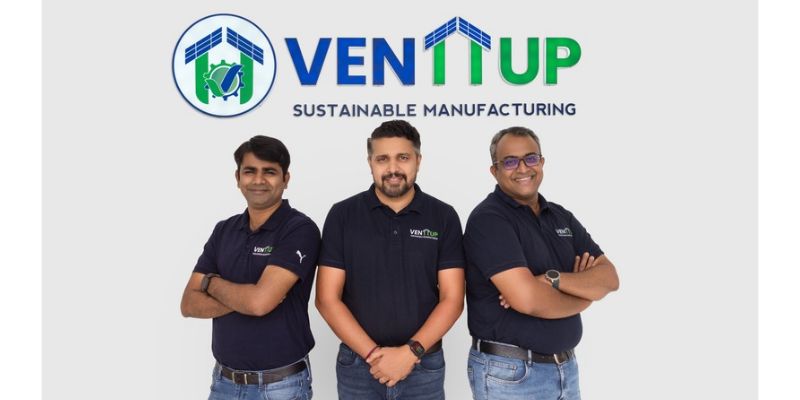
Venttup Raises $3 Million to Scale Precision Manufacturing
Venttup has raised $3 million in a Pre-Series A round to expand its engineering and manufacturing capabilities for critical sectors.
Read moreAutomation & Robotics

Critical Manufacturing will grow with India's semiconductor industry: Weng Keong
In this interview with Rakesh Rao, Weng Keong, MD, Critical Manufacturing Malaysia, discusses smart factories, digital infrastructure and India’s semiconductor manufacturing potential.
Read moreAutomation & Robotics
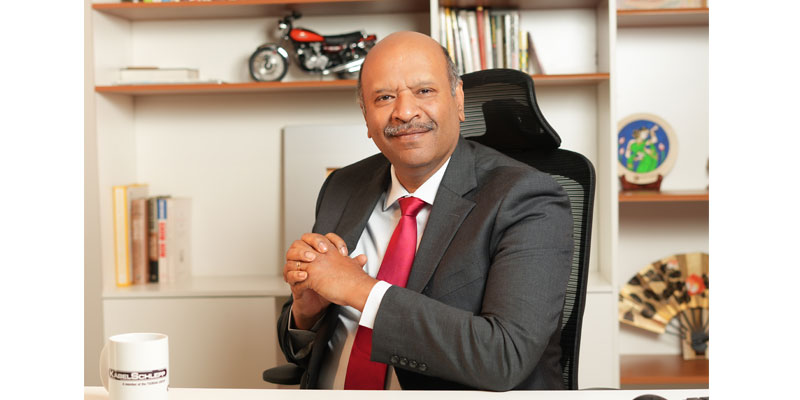
Reimagining Cable Management in the Age of Smart Manufacturing
As factories become smarter, Srinivas P Kamisetty, MD, Kabelschlepp India, explains how advanced cable management enables reliable automation and efficient manufacturing.
Read moreRelated Products
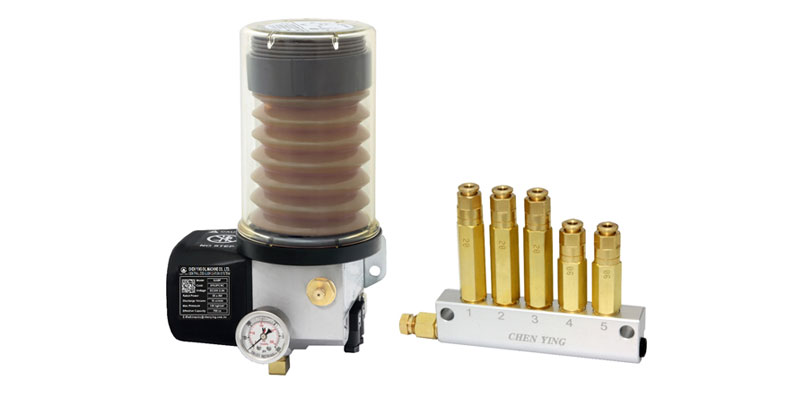
KABP-07 Electric Grease Lubricator
MACHINE TOOLS, POWER & HAND TOOLS
The KABP-07 features an efficient planetary gear motor and concealed safety switches. Paired with CFB Volumetric Distributors, it ensures consistent lubrication for industrial applications.
Read more
Hittco -SOLID Carbide Drills Engineered For Performance
MACHINE TOOLS, POWER & HAND TOOLS
Hittco Tools Ltd offers a wide range of hittco-solid carbide drills engineered for performance.
Read morelatest News
Subscribe to iNoW

For Industry News on WhatsApp, Give a Miss Call on: +91 84228 74016

Log In
To Contact this Supplier
Please Log In to your Account

INDUSTRIAL PRODUCTS FINDER (IPF) is India’s only industrial product portal. Referred to as the ‘Bible’ of the manufacturing sector in India,
SPECIAL OFFER

Hi There!
Now get regular updates from IPF Magazine on WhatsApp!
Click on link below, message us with a simple hi, and SAVE our number
You will have subscribed to our Industrial News on Whatsapp! Enjoy