






Schedule a Call Back


Future Factory Expo Webinar Discusses Rise of Smart Machines in Manufacturing
 Articles
- Sep 26,26
Smart Manufacturing & Enterprises, along with Future Factory Expo (FFE), hosted the webinar to explore how intelligent machines are enabling data-driven decision-making, higher productivity and sustainable manufacturing operations, reports Rakesh Rao
Manufacturing is entering a new era where machines are evolving beyond conventional production assets into intelligent, connected and self-optimising systems. With automation, artificial intelligence (AI) and the Internet of Things (IoT) becoming central to industrial transformation, factories are increasingly adopting smart machines capable of adapting to changing production requirements, enabling real-time monitoring and supporting data-driven decision-making.
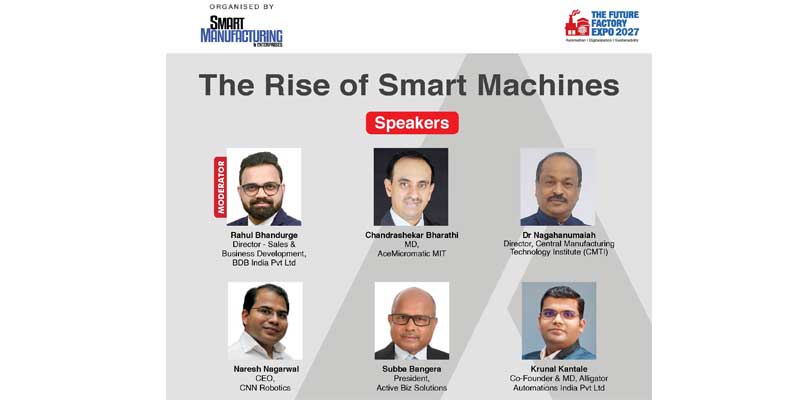
Against this backdrop, Smart Manufacturing & Enterprises (SM&E) magazine and Future Factory Expo 2026 (FFE 2026), under the “Future-Ready Factories Webinar Series”, hosted an online panel discussion titled “The Rise of Smart Machines” on September 18, 2026. The session explored how smart machines are transforming factory shopfloors and accelerating the shift towards intelligent manufacturing.
Moderated by Rahul Bhandurge, Director - Sales & Business Development, BDB India Pvt Ltd, the discussion brought together industry experts including Chandrashekar Bharathi, MD, AceMicromatic MIT; Dr Nagahanumaiah, Director, Central Manufacturing Technology Institute (CMTI); Krunal Kantale, Co-Founder & MD, Alligator Automations India Pvt Ltd; Naresh Nagarwal, CEO, CNN Robotics; and Subba Bangera, Chairman, Active Biz Solutions Pvt Ltd.
The discussion focused on the evolution of smart machines, the role of machine builders, technology providers and institutes in developing intelligent manufacturing solutions, the importance of robotics, AI, IoT and machine vision, and the need to build sustainable and future-ready factories.
The evolution of smart machines
Opening the session, Rahul Bhandurge highlighted that smart machines represent the next stage of industrial evolution. He explained that these machines are capable of detecting inputs, learning from data, making decisions, optimising processes and continuously monitoring output quality.
“Smart machines are going to be the fundamental building blocks for connected factories, intelligent manufacturing systems, predictive maintenance, industrial IoT, AI-driven operations and autonomous production environments,” he said.
He added that manufacturers today are seeking answers to critical questions around improving productivity, increasing operational efficiency, accelerating Industry 4.0 adoption and balancing profitability, sustainability and resilience through intelligent automation.
Chandrashekar Bharathi explained that the journey towards smart manufacturing begins with creating visibility across factory operations. According to him, conventional machines often operated with limited visibility, where decisions were based on experience, assumptions and historical practices rather than real-time information.
He explained that the transformation towards intelligent machines follows a five-step journey. The first step is making machines connectable, followed by real-time visibility, understanding why something is happening, predicting future outcomes and finally achieving a closed-loop manufacturing ecosystem where data is processed and used to improve productivity, quality, safety and other critical parameters.
“Today, we are moving from guessing what is happening on the shopfloor to making decisions based on data,” he explained.
Rahul Bhandurge highlighted this shift, stating that manufacturing is moving from experience-based decisions made by individuals on the shopfloor to data-driven decision-making supported by connected systems.
Building indigenous capabilities for smart machines
Discussing the role of indigenous development, Dr Nagahanumaiah emphasised that smart machines require multiple technological capabilities working together. He explained that sensing, automation, decision-making, communication and flexibility are all essential elements of intelligent machines.
However, developing such systems requires expertise across multiple domains, including machine design, manufacturing processes, electronics, software, controls, computer science and areas such as computer vision.
He pointed out that India’s journey towards developing smart machines requires collaboration between industries, research institutions and technology partners. While companies can adopt different approaches — including purchasing technology, collaborating with established global players or developing solutions internally — the long-term objective should be building domestic technological capabilities.
Dr Nagahanumaiah also cautioned against over-engineering machines simply by adding unnecessary features. Instead, machines should be designed around actual customer requirements, cost efficiency and adaptability. “The machines need not be over-engineered. We should look at what is required, what is the key performance parameter and how the machine can be built accordingly,” he explained.
He further highlighted the importance of modular and reconfigurable machines that can adapt to changing market requirements while remaining economically viable.
Automation driving productivity and flexibility
Krunal Kantale explained that smart machines are transforming manufacturing by improving productivity, flexibility and operational efficiency. He highlighted that productivity improvement is not only about increasing machine speed but also about reducing hidden losses such as stoppages, manual interventions, errors and changeover delays.
He explained that connected automation enables machines to provide real-time information and support informed decision-making. Using the example of robotic palletising systems, he highlighted how smart systems can manage disruptions by creating flexibility within production lines rather than bringing operations to a complete halt.
According to him, flexibility is shifting from manual adjustments to software-driven adjustments. With robotics, servo systems, vision technology and AI, machines can dynamically adapt to different products, sizes and production requirements. “Flexibility is moving from manual adjustment to software-driven adjustment,” he explained.
He added that smart machines are also enabling manufacturers to move from reactive maintenance to predictive maintenance by collecting operational data through sensors and IoT-enabled devices.
AI, machine vision and the future of autonomous factories
Naresh Nagarwal emphasised that the true value of smart machines lies not in individual automation systems but in creating connected ecosystems where machines, sensors, cameras and AI technologies work together.
Sharing an example, he explained how AI-enabled systems can analyse parameters such as size, shape and colour to make decisions without manual intervention. Such systems can automatically classify products, adjust processes and improve productivity.
He highlighted that predictive maintenance will play a crucial role in future factories by allowing manufacturers to understand machine conditions based on actual usage rather than fixed maintenance schedules.
“Smart machines are not just about having a machine; the key question is why we need a smart machine,” he said.
He also discussed the emergence of autonomous and even “dark” factories where machines, robots, automated guided systems and production processes operate with minimal human involvement, particularly in environments where safety risks are high.
Smart machines for sustainable manufacturing
Subba Bangera highlighted the role of smart machines in improving energy efficiency and sustainability. He explained that manufacturing equipment has evolved from hydraulic systems to electric systems using servo motors, resulting in significant energy savings.
He pointed out that factories are increasingly adopting renewable energy solutions such as solar power to reduce energy consumption and operating costs.
Discussing sustainability at the machine level, he explained that smart machines help reduce energy wastage by optimising processes such as heating and cooling. Better control systems ensure that defective inputs are identified early and waste generation is minimised.
He also highlighted the importance of autonomous maintenance, where operators are equipped with information and capabilities to address issues without depending entirely on separate maintenance teams.
“The operator running the machine should know what to fix when it happens. That is where autonomous maintenance is coming into manufacturing,” he explained.
He further shared how remote monitoring and support have become increasingly important, especially after the COVID period, enabling engineers to support machines globally without physical presence.
Preparing for the future of manufacturing
The discussion highlighted that smart machines are becoming essential for manufacturers seeking higher productivity, flexibility, sustainability and competitiveness. From connected machines and predictive maintenance to AI-driven decision-making and autonomous operations, intelligent systems are redefining the future of manufacturing.
The webinar also reinforced the need for collaboration between machine builders, technology providers, research institutions and manufacturers to accelerate India’s transition towards Industry 4.0.
As manufacturing continues to evolve, platforms such as Future Factory Expo 2027 (FFE 2027), scheduled in March 2027, will provide an important opportunity for industry leaders, technology providers and manufacturing professionals to explore emerging technologies, exchange knowledge and build partnerships that can shape the factories of tomorrow.
Participation in FFE 2027 will enable stakeholders to engage with the latest developments in automation, digitalisation, robotics, AI and smart manufacturing solutions while connecting with the ecosystem driving India’s future-ready factories.
Smart machines
Future Factory Expo
Industry 4.0
automation
artificial intelligence
IoT
robotics
predictive maintenance
smart factories
Chandrashekar Bharathi
AceMicromatic MIT
Dr Nagahanumaiah
Central Manufacturing Technology Institute
CMTI
Krunal Kantale
Alligator Automations India
Naresh Nagarwal
CNN Robotics
Subba Bangera
Active Biz Solutions
Rahul Bhandurge
BDB India
smart manufacturing
Related Stories
Material Handling Equipment
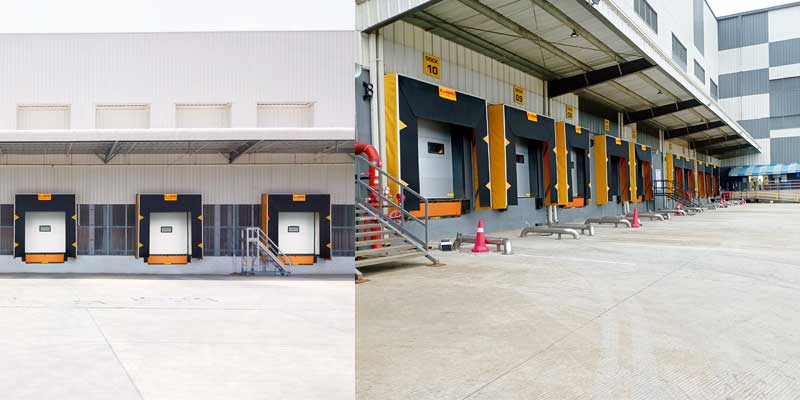
Gandhi Automations strengthens loading bays with advanced dock shelters
Gandhi Automations offers retractable, cushion and inflatable dock shelters designed to improve loading bay safety, insulation, energy efficiency and protection
Read moreSmart Manufacturing
Operational Optimisation: Automation – When And How Much?
As we put our efforts into optimising our operations, we journeyed from discussions on operational flow, including the “why”, “where”, “what” and “how”, before looking at data-based ..
Read moreSmart Manufacturing
Future Factory Expo Webinar Discusses Rise of Smart Machines in Manufacturing
Smart Manufacturing & Enterprises, along with Future Factory Expo (FFE), hosted the webinar to explore how intelligent machines are enabling data-driven decision-making, higher productivity and sust..
Read moreRelated Products
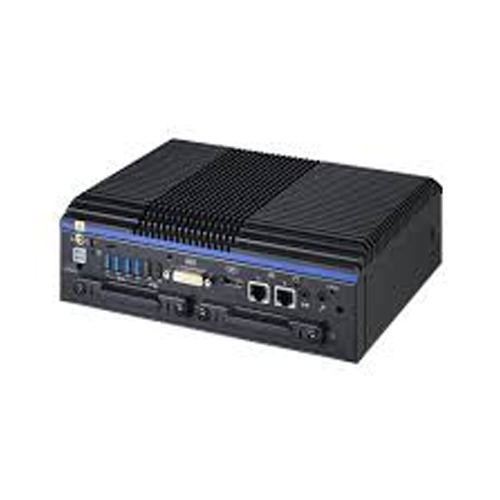
Fanless Industrial Pc for Smart Manufacturing
Smart Manufacturing
CONTEC Launches BX-M4600 Series - Fanless Industrial PC for Smart Manufacturing.
latest News
Subscribe to iNoW

For Industry News on WhatsApp, Give a Miss Call on: +91 84228 74016