







Schedule a Call Back


Aerospace demands precision, traceability and discipline: Sanjay Patel
 Articles
- Aug 27,26
Sanjay Patel discusses Tembo Global’s shift into aerospace and UAV manufacturing, focusing on precision, localisation and global capabilities, in conversation with Ashlin Rajan.
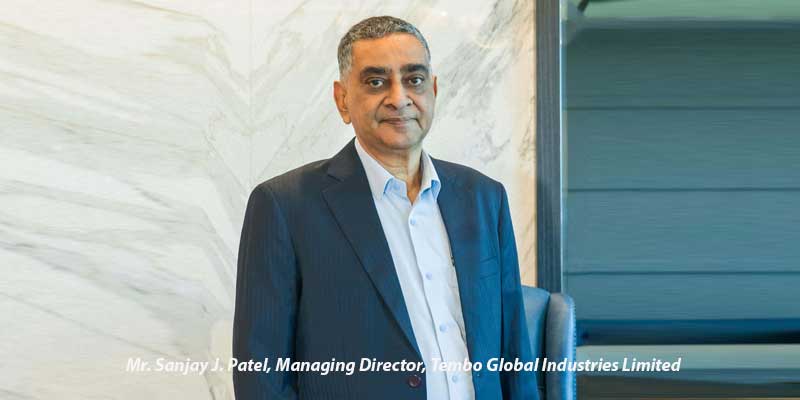
How has Tembo Global’s manufacturing journey evolved, and what capabilities support its entry into aerospace and UAVs?
Tembo Global’s manufacturing journey has evolved from building strong capabilities in engineering components and industrial solutions to developing a diversified manufacturing ecosystem serving demanding sectors such as oil & gas, power, construction, defence and industrial engineering.
Over the years, we have continuously invested in advanced manufacturing processes, precision engineering, quality systems and skilled technical manpower, enabling us to handle increasingly complex and application-critical requirements. This experience has given us a strong foundation in design-to-manufacturing, material selection, precision fabrication, quality control and supply-chain execution. These capabilities are particularly relevant as we enter the aerospace and UAV segment, where precision, reliability, consistency and stringent quality standards are critical.
Our established engineering expertise, manufacturing infrastructure and experience of working with high-performance industrial applications position us well to develop and manufacture specialised components and assemblies for the growing aerospace and unmanned systems ecosystem.
What technologies and quality systems are needed to manufacture UAV components to global standards?
Producing UAV components to international aerospace and defence standards will require advanced manufacturing capabilities such as 5-axis CNC machining, precision turning and milling, laser cutting, specialised forming, welding and, where required, composite manufacturing and additive manufacturing. These technologies must deliver high dimensional accuracy, consistency and lightweight, high-performance components.
Equally important will be robust quality-control and traceability systems, including CMMs (Coordinate Measuring Machines) and other precision metrology equipment, non-destructive testing, material traceability, SPC (Statistical Process Control), calibration management and digital production monitoring. Compliance with aerospace quality standards such as AS9100, along with applicable defence and customer-specific requirements, will be critical to ensuring reliability, repeatability and international acceptance of UAV components.
How is Tembo investing in the Kashidkopar facility, and how scalable is its UAV capacity?
We are making a strategic investment in our Kashidkopar facility to build a strong and scalable manufacturing base for our UAV business. The investment is being directed towards strengthening production infrastructure, technology, testing capabilities and operational readiness.
Importantly, the facility has been planned with scalability in mind, allowing us to progressively expand capacity as demand and order volumes increase. Rather than building capacity only for current requirements, our approach is to create a flexible platform that can support significant volume growth in the coming years while maintaining quality, precision and delivery standards.
What localisation levels is Tembo targeting for UAV components over the next three to five years?
At the initial stage, we expect a significant proportion of the components, materials and sub-assemblies used in production to be sourced from India, with localisation levels varying depending on the product category and technical requirements.
Our objective is to progressively increase domestic sourcing by developing a stronger ecosystem of Indian suppliers, improving component capabilities and reducing dependence on imports.
Over the next three to five years, we aim to achieve a substantially higher level of localisation, with the goal of sourcing the majority of our production requirements domestically wherever technically and commercially feasible.
What technical expertise will Tembo gain from its European and Japanese JV partners?
Tembo Global expects to benefit significantly from the technical know-how and manufacturing expertise of its European and Japanese JV partners. The collaboration will provide access to advanced manufacturing processes, engineering practices, quality-control systems and international standards, along with their experience in product development and process optimisation. We also expect knowledge sharing in areas such as automation, precision manufacturing, productivity enhancement and application-specific engineering.
This transfer of expertise will strengthen Tembo Global’s manufacturing capabilities, improve operational efficiency and quality, and help us develop products that meet global standards while creating a stronger technology and manufacturing base in India.
What are the key challenges in transitioning to aerospace manufacturing, and how is Tembo preparing its workforce?
The biggest technical challenge in moving from conventional industrial engineering to precision aerospace and UAV manufacturing is the much higher level of accuracy, consistency, traceability and process discipline required. Aerospace components often demand tight tolerances, advanced materials, specialised machining and stringent quality controls, where even minor deviations can affect performance and reliability.
At Tembo Global Industries Limited, we are addressing this transition by investing in advanced manufacturing capabilities, process automation, precision inspection and quality systems, while continuously upgrading our engineering practices. Equally important is developing the right talent.
We are focusing on hands-on training, cross-functional learning and upskilling our engineers and shop-floor teams in areas such as precision machining, metrology, advanced manufacturing processes and aerospace-quality standards.
Our objective is to build a workforce that combines strong conventional engineering fundamentals with the specialised skills needed for next-generation aerospace and UAV manufacturing.
Which domestic and global markets is Tembo targeting for its UAV business?
Our UAV business is being developed with a diversified market approach, covering both domestic and international opportunities. In India, we see strong potential across defence, homeland security, surveillance, infrastructure monitoring, agriculture and other commercial applications. We are also evaluating opportunities in international markets where demand for reliable and cost-effective UAV solutions is growing.
We are in discussions with relevant stakeholders across the defence and technology ecosystem, including potential collaborations with Indian defence organisations, private-sector companies and global UAV technology players. Our focus is to build long-term partnerships and develop solutions that combine advanced technology, operational reliability and scalable manufacturing capabilities.
What scale do you envision for Tembo’s defence and aerospace business over the next three to five years?
Over the next three to five years, we see defence and aerospace emerging as a significant growth engine for Tembo Global Industries. Our focus will be on steadily expanding our manufacturing footprint, strengthening our engineering and R&D capabilities, and developing a broader portfolio of precision-engineered components and assemblies for defence and aerospace applications. We aim to build deeper capabilities across the value chain, while maintaining the quality, reliability and stringent standards required by these sectors.
In terms of revenue, we expect the business to make a meaningful and growing contribution to the company’s overall revenues, supported by increasing domestic defence procurement, opportunities in aerospace manufacturing and the broader shift towards indigenous sourcing.
Our objective is not simply to increase capacity, but to build a scalable, technology-led and globally competitive defence and aerospace business that can create sustainable long-term value for Tembo Global.
Aerospace Manufacturing
UAV Manufacturing
Precision Engineering
Defence Manufacturing
Localisation
Advanced Manufacturing
Technology Transfer
Aerospace Quality Standards
Sanjay Patel
Tembo Global Industries Limited
Ashlin Rajan
Related Stories
Smart Manufacturing

Clean manufacturing is key to India’s future growth: Yash Kashyap
Yash Kashyap, India Lead, Industrial Transition Accelerator, shares insights with Ashlin Rajan on industrial decarbonisation, clean manufacturing, green technologies and India’s transition towards..
Read moreConstruction Equipment
Future factories will integrate mechanical and digital tech: Sachin Tare
With manufacturing becoming increasingly technology-driven, Sachin Tare, Director – Manufacturing, CASE Construction Equipment, shares his perspective with Ashlin Rajan on automation, digitalisati..
Read moreConstruction Equipment

Make in India must beat imports on competitiveness: Abhishek Bhatia
In this interview with Ashlin Rajan, Abhishek Bhatia, Managing Director and Partner, Boston Consulting Group, shares insights on India’s construction equipment sector, and its roadmap towards beco..
Read moreRelated Products
Troop Comforts revolutionises military gear with indigenous innovations
Aerospace & Defence
Troop Comforts Ltd (TCL), a state-owned defence corporation, has recently received a request for proposal (RFP) from the Northern Command of the Indian Army for its indigenously developed military gea Read more
latest News
Subscribe to iNoW

For Industry News on WhatsApp, Give a Miss Call on: +91 84228 74016