







Schedule a Call Back


New exposure limits bring tungsten risks into the spotlight
 Articles
- Nov 27,26
As Australia’s new exposure limits approach, Samantha Gonzalez, Business Development Manager, Welding Automation examines the risks of tungsten electrode grinding and practical ways to control dust at its source.
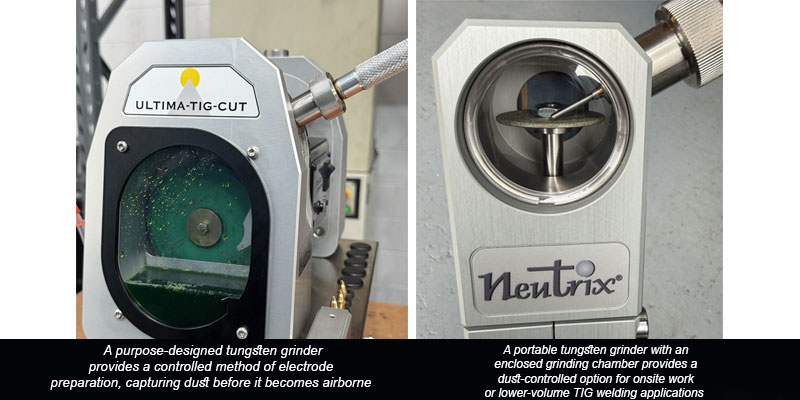
Every day in workshops across the country, tungsten inert gas (TIG) welders are sharpening tungsten electrodes dozens of times a shift. This preparation process is essential and takes only a few seconds, and a usable point can be achieved with a bench grinder, angle grinder, or similar tool readily available in most workshops. Yet, when tungsten is ground, fine dust particles can be released into the air, creating an exposure risk that has long been underestimated or dismissed.
Until now, there has been little external pressure to change what has become standard practice. From 1 December 2026, that changes. Australia’s new Workplace Exposure Limits (WEL) for airborne contaminants will include ‘tungsten, metal and compounds (as W)’, bringing tungsten dust exposure risks sharply into focus.
A routine task now under review
Welding fumes have been the major topic of welding safety discussions in recent years, and rightly so – but it is now time to widen the focus.
A solid tungsten electrode is not cause for concern, but exposure risks arise when tungsten is ground to create the sharpened point required for welding. Under standard workshop practices, the use of an open grinding wheel during this process can release fine tungsten dust into the surrounding air.
That dust is a key reason this routine task will soon sit within a clearer regulatory frame. Under the new WEL framework, workplaces must ensure no person is exposed to an airborne contaminant above its relevant limit, and ‘tungsten, metal and compounds (as W)’ will be listed at three milligrams per cubic metre as an eight-hour, time weighted average.
While the eight-hour average is important, workplaces still need to consider how exposure occurs in practice. Electrode sharpening happens in short, repeated bursts, often close to the operator’s
breathing zone, where dust may be more concentrated. Without specialised air monitoring, exposure levels can be difficult to assess, but the health risks associated with tungsten dust are clear enough to warrant closer attention.
The health risks of tungsten exposure
The dust generated during tungsten grinding is often incredibly fine and not always visible in the air. Once airborne, these particles can be inhaled deep into the respiratory system, where they may irritate the lungs and, with repeated exposure, contribute to more serious lung-related health effects.
The risk is not limited to inhalation. Tungsten dust can also irritate the eyes and skin, and may be ingested if residue transfers from hands, gloves, clothing or work surfaces. Because the particles can settle on nearby surfaces, poor housekeeping can also extend the exposure risk beyond the grinding task itself.
Importantly, the risk is not limited to the person sharpening the electrode. Airborne dust can move through shared work areas, meaning nearby workers may also be exposed even if they are not directly involved in the grinding task.
Even more care is required where thoriated tungsten electrodes are used. When ground, these electrodes can produce fine particles containing thorium, a radioactive material that introduces additional risk if inhaled or ingested.

A simple change: control dust at the source
Exposure monitoring, personal protective equipment, ventilation, housekeeping and training all have a role to play in managing airborne contaminants. In the case of tungsten electrode grinding, however, the most direct opportunity is to stop dust becoming airborne in the first place.
For many workplaces, the simplest step is to replace open grinding with a dedicated tungsten grinder designed for dust control. Instead of sharpening the electrode against an exposed wheel, these machines contain the grinding process inside an enclosed chamber, capturing tungsten dust at the point it is created.
This gives workplaces a controlled method for sharpening electrodes, collecting dust and managing disposal, so they don't have to rely on an open wheel that allows particles to escape into the surrounding air.
As an additional step, workplaces using thoriated electrodes should also review whether a lanthanated or ceriated alternative will do the job, as this removes thorium from the dust altogether.
A controlled option for every set-up
Open grinding is often kept in place because it is convenient. Electrodes can be sharpened quickly at a bench, beside a welding bay or out onsite, which is why the practice has remained commonplace. Convenience, however, should not come at the expense of safety, particularly when controlled options are available for different use cases.
For workplaces preparing a high volume of electrodes at a fixed station, a bench-mounted tungsten grinder makes sense. Grinding, dust collection and disposal can all be managed in one place, creating a more consistent and contained approach to electrode preparation.
For onsite work or workshops with a lower volume of TIG welding, a portable tungsten grinder may be the more practical option. Provided the model still offers an enclosed grinding chamber and dust filtration system, portability and convenience can be maintained without defaulting back to an angle grinder.
In both cases, a dedicated tungsten grinder can improve operator safety beyond dust control. Removing the need to hold the electrode close to an exposed wheel reduces the risk of hand and fingertip injuries, and limits hazards such as eye injuries from fragments. A dedicated grinding process can also improve quality by reducing the risk of cross contamination from shared general-purpose wheels.
What to review before the deadline
The transition to WEL gives workplaces a timely reason to review how tungsten electrodes are prepared, and whether current practices are still appropriate.
For many workplaces, that review may be straightforward. If electrodes are still being sharpened on an open bench grinder or angle grinder, the process should be reconsidered. An enclosed tungsten grinder designed for dust control offers a simple way to contain grinding, collect dust and reduce exposure risk.
Where dedicated equipment is already in use, the focus should be on whether it is being used correctly, maintained properly, and supported by safe procedures for dust collection and disposal. Workplaces should also identify whether thoriated electrodes are in use, and whether an alternative electrode type is suitable.
Why change should not wait
The inclusion of tungsten metal in Australia’s new WEL is more than a technical change to a table of airborne contaminants. It is a clear signal that tungsten dust needs to be treated with the same seriousness as other recognised exposure risks in manufacturing environments.
For workplaces still relying on open grinding, the question is no longer whether the process has worked well enough in the past; it is whether that process is appropriate for the expectations now being placed on dust control, worker safety and exposure management.
The WEL transition provides a clear reason to review the process, but safety should be the motivation to take the next step. If a routine practice is creating an exposure risk in your workplace and a practical way to reduce that risk exists, the case for change is already there. Don’t wait for the December deadline to act.
About the author:
Samantha Gonzalez is the Business Development Manager at Welding Automation.
Article Courtesy: SWIT
Tungsten dust
TIG welding
electrode grinding
Workplace Exposure Limits
Australia WEL
dust control
enclosed tungsten grinders
thoriated electrodes
workshop safety
occupational exposure
Samantha Gonzalez
Wielding Automation
Related Stories
Fabrication
New exposure limits bring tungsten risks into the spotlight
As Australia’s new exposure limits approach, Samantha Gonzalez, Business Development Manager, Welding Automation examines the risks of tungsten electrode grinding and practical ways to control dus..
Read moreFabrication

Achieve Maximum Freedom in Mobile MMA Welding with the Ignis Battery
The Ignis Battery impresses with functions that make welding easier, safer, and more efficient. HotStart and SoftStart ensure optimum ignition for rutile, basic, or CEL electrodes.
Read moreFabrication
Advantages of TIG welding with dynamically regulated wire feed speed
TIG welding enables higher productivity in manual welding and can be easily automated.
Read moreRelated Products
Spot Welding Machine
WELDING, SOLDERING & CRIMPING SYSTEMS
Vijay Electricals offers a wide range of portable spot welding machine.
Read more
Welding Machine
WELDING, SOLDERING & CRIMPING SYSTEMS
Mehta Sanghvi & Company offers MCM door frame welding machine for wind towers.
Read more
Hardy - Chassis Mounted Weighing Card for Rockwell PLCs
WELDING, SOLDERING & CRIMPING SYSTEMS
Kore Mechatronics Private Limited offers a wide range of
hardy - chassis mounted weighing card for Rockwell PLCs.
latest News
Subscribe to iNoW

For Industry News on WhatsApp, Give a Miss Call on: +91 84228 74016