








Schedule a Call Back


The Growing Demand For Tool-Robot Synergy
 Articles
- Nov 27,26
As surgical robots evolve, compact motors must deliver greater power, precision and reliability. Early collaboration between OEMs and motion partners will shape the next generation, writes Antonio Herrera, Global Strategic Marketing (Surgical and Industrial Robotics) at Portescap.
1496x62At the technical level, what separates today’s surgical robotics from earlier generations is the degree to which the motion system and the platform are co-designed. The demands placed on the motion side of the equation have grown in three directions at once: more power within smaller volumes, more precise control over each movement, and greater reliability across thousands of procedures and sterilisation cycles.
Meeting any one of these is a significant engineering task. Meeting all three simultaneously is the challenge that truly defines the modern surgical robot.
Power density is the starting point. The space envelope available at the working end of a robotic arm is limited, but the torque required to drive surgical tools is not. A motor that can deliver high torque in a compact, lightweight package is a prerequisite, and optimising the torque-to-mass ratio is central to allowing OEMs to design systems that are responsive without becoming unwieldy.
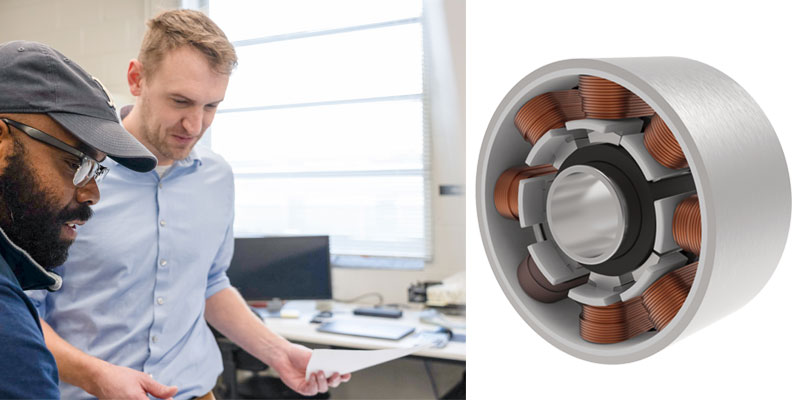
This is where frameless motors have emerged as a design response worth understanding. A frameless motor is stripped down to its essential components — the stator and rotor — and foregoes the traditional housing, bearings, and shaft. Instead of mounting a packaged motor into the joint, the designer integrates the rotor and stator directly into the joint or end-effector assembly, using the robot’s own structure as the motor’s mechanical foundation.
The gains are exactly the ones the application demands: weight and space savings from eliminating redundant structure, a high torque-to-inertia ratio for responsive motion, better cooling through direct thermal contact with the surrounding assembly, and fewer mechanical losses. For the control axes of joints and end effectors, where every gram and millimetre matters, this direct integration is increasingly the difference between a design that fits and one that does not.
The need for reliability ties all this together. Despite no longer being fringe technology, surgical robots remain expensive systems that cannot easily be swapped out, and any motion component must withstand repeated sterilisation without performance degradation. This requirement affects every aspect of the design—from materials and sealing strategies to feedback devices and lubrication—and must be engineered in from the outset, not addressed during qualification.

Why the industry is leaning on collaboration
Look closely at any of these design decisions and a pattern emerges: almost every one is a trade-off that crosses an organisational boundary.
Consider the choices a design team actually faces. More torque in a sealed, sterilisation-ready housing means more heat and fewer ways to dissipate it. Where, then, should the thermal budget sit—in the motor design or the host assembly?
A smaller motor may need a higher gear ratio to deliver the same output, trading compactness against backlash and control fidelity. Higher feedback resolution improves precision but adds conductors, connectors, and sealing challenges to a device that must survive sterilisation. And a fully optimised custom design can outperform a standard one, but at a cost in development time, manufacturability, and unit economics that may never be recovered. No single team owns both sides of these equations.
The OEM understands the procedure, the system architecture, and the commercial envelope; the motion partner understands what the physics of the motor allows, what can be manufactured repeatably, and where an ambitious specification will collide with production reality. This is why the industry has shifted so decisively toward early, engineer-to-engineer collaboration, and why promising subsystems developed in isolation so often stall on the way to production, when it is discovered too late that the design was never economical to manufacture.
Bringing the motion partner in while the device’s basic geometry is still being defined allows these trade-offs to be resolved while they are still design choices, rather than becoming reasons for a redesign.
Preparing for the next wave of growth
These pressures will only intensify as the industry enters its next phase of growth. To date, surgical robotics has concentrated in large, well-funded hospitals in major urban centres, where the capital cost of a flagship system can be amortised over high procedure volumes. The next wave will look different.
Adoption is expected to extend into smaller and rural facilities and into markets across Asia, Africa, and Latin America, where the economics of today’s flagship systems simply do not work. Increasingly, surgical robotics will be used in Ambulatory Surgery Centres (ASCs), also known as outpatient surgery centres, which have a need for scalable, flexible and efficient equipment.
That will not mean selling the same machines more cheaply. Rather, it will mean designing different ones: smaller, lighter, more flexible systems that deliver perhaps seventy to eighty per cent of a flagship’s capability at a fraction of the cost and footprint, well-suited to handling the majority of procedures and to operating in less specialised environments.
Achieving this without sacrificing the power, precision or reliability essential to safe and effective surgical robotics is a motion-design and manufacturing challenge. Early engineer-to-engineer collaboration, which has supported the development of today’s flagship systems, will become even more important as the industry develops platforms for a new economic context and adapts them to the specific needs of ASCs.
Choosing a motion partner for the long road ahead
Taken together, these three trends point in the same direction. The technical demands of tool-robot synergy, the long timelines that reward collaboration, and the cost pressures of the next wave of growth all converge on the same conclusion: the choice of motion partner has become a strategic decision rather than a transactional one.
OEMs need a partner with the engineering depth to act as an extension of their team, the commercial focus to design for cost-effective, high-volume manufacturing, and the global footprint to support development and production wherever a programme needs to be delivered.
The OEMs that will define the next phase of surgical robotics are those that treat motion not as a component to be procured, but as a system-level decision made early, made together, and made to last.
About the author
Antonio Herrera is the Global Strategic Marketing (Surgical and Industrial Robotics) at Portescap - a member of Regal Rexnord. Portescap’s extensive product range powers applications across the aerospace and defense, automation, industrial power tools, medical, robotics, and surgical hand tool industries.
Portescap
Regal Rexnord
tool-robot synergy
surgical robotics
system-level decision
frameless motors
collaboration
Antonio Herrera
Related Stories
Automation & Robotics
The Growing Demand For Tool-Robot Synergy
As surgical robots evolve, compact motors must deliver greater power, precision and reliability. Early collaboration between OEMs and motion partners will shape the next generation, writes Antonio H..
Read moreGears, Motors & Drives

2025 Geared Motor Market: Leading Manufacturers Maintain their Dominance
The geared motor and industrial gear market remained concentrated in 2025, with leading players holding share as regional competition diverged and Chinese manufacturers expanded overseas, examines R..
Read moreAuto & Auto Components

Stellantis and Tata Motors Expand Vehicle Technology Partnership
Stellantis, TMPV and TPEM have signed an agreement to expand vehicle technology collaboration, with vehicles to be manufactured in India for more than 50 global markets.
Read moreRelated Products
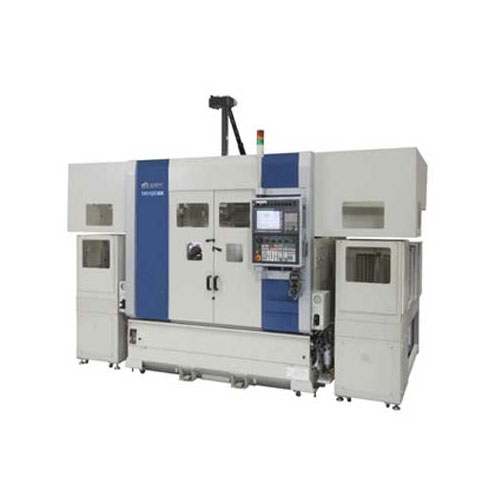
Compact Fmc - Motorum 3048tg With Fs2512
INDUSTRIAL AUTOMATION & TECHNOLOGY CONSULTANCY
Meiban Engineering Technologies Pvt Ltd offers a wide range of Compact FMC - Motorum 3048TG with FS2512.
Digital Colony Counter
INDUSTRIAL AUTOMATION & TECHNOLOGY CONSULTANCY
Rising Sun Enterprises supplies digital colony counter.

Robotic Welding SPM
INDUSTRIAL AUTOMATION & TECHNOLOGY CONSULTANCY
Primo Automation Systems Pvt. Ltd. manufactures, supplies and exports robotic welding SPM.
latest News
Subscribe to iNoW

For Industry News on WhatsApp, Give a Miss Call on: +91 84228 74016