








Schedule a Call Back


KPMG calls for workforce productivity revolution to drive India’s manufacturing
 Industry News
- Sep 03,26
KPMG says workforce productivity is India’s most underleveraged growth lever, with a productivity revolution needed to achieve the country’s $7.5 trillion manufacturing ambition.

As India aspires to become a $ 30 trillion economy by 2047,
manufacturing will need to serve as a critical engine of growth, employment and
competitiveness. However, achieving the national vision of a $7.5 trillion
manufacturing sector contributing 25 per cent of GDP will require the industry
to fundamentally rethink how work is done, organisations are designed and
talent is deployed.
KPMG in India’s latest report, India’s Trillion-Dollar
Manufacturing Ambition Requires a Workforce Productivity Revolution, argues
that workforce productivity is India’s most underleveraged growth lever and a
critical enabler of the country’s manufacturing ambitions.
The report is based on research across 130+ large Indian
manufacturing companies and demonstrates the relationship between workforce
productivity, profitability and enterprise value creation. The findings reveal
that while India has made significant progress in manufacturing growth, current
productivity levels remain insufficient to bridge the gap between today’s
manufacturing output and the scale required to meet the country’s 2047
aspirations.
At the current trajectory, Indian manufacturing is expected
to reach only about $ 2.7 trillion by 2047, leaving a substantial gap against
the $7.5 trillion target. The report identifies workforce productivity as the
lever with the greatest potential to create sustained competitive advantage, as
productivity gains become permanently embedded within organisations, improving
output, profitability and resilience year after year.
The report also highlights what it calls the “productivity
illusion” facing many manufacturing organisations, where high levels of activity
are often mistaken for high performance. Hidden inefficiencies, including
excessive management layers, fragmented roles, weak supervisory capability,
dependence on tribal knowledge, contract workforce capability gaps and
reporting overload, continue to erode throughput, quality, margins and capital
returns despite significant effort across operations.
As manufacturing leaders contend with margin pressures,
geopolitical uncertainty, evolving competitive dynamics and the growing
influence of AI, the report introduces the Productivity Triad, a practical
framework that enables organisations to unlock productivity gains by
simultaneously reimagining work, redesigning organisations and remodelling the
workforce, amplified through digital technologies, AI, performance management
and organisational culture.
Sunit Sinha, Partner
and Head, Human Capital Advisory Solutions (HCAS), KPMG in India, said, “Workforce productivity
is India’s most underleveraged growth lever. The next era of manufacturing
competitiveness will not be won only by adding more people or assets, but by
fundamentally redesigning how work gets done. Organisations that act now can
unlock significant value, accelerate growth, strengthen profitability and help
power the next chapter of India’s manufacturing journey.”
Sharad Maloo,
Partner, Human Capital Advisory Solutions (HCAS), KPMG in India, said,
“Many organisations continue to face a productivity illusion, where high levels
of activity disguise underlying inefficiencies. Sustainable productivity gains
will require businesses to simplify structures, strengthen frontline
capability, codify critical knowledge and build workforce models that can adapt
to changing business needs. Organisations that take a systematic approach to
productivity transformation will be better positioned to improve performance
and competitiveness.”
Key findings from the
report include:
- India’s manufacturing sector will need to expand nearly 15
times, from approximately $ 0.5 trillion today to $ 7.5 trillion by 2047, requiring
around 13 per cent annual growth, significantly above the current trajectory.
- Research across 130+ large manufacturing companies
demonstrates a strong positive relationship between workforce productivity and
enterprise value creation, with over 90 per cent of companies falling within a
productivity-value zone.
- Organisations leading on productivity achieved 50 per cent+
higher profitability growth and nearly 2x market capitalisation growth compared
to peers over a ten-year period.
- Productivity variance across manufacturing companies can
range from 300 per cent to 1000 per cent, making workforce productivity one of
the sector’s most significant untapped growth opportunities.
- A sustained 30 per cent productivity gain could drive nearly
35 per cent of future manufacturing output, creating long-term advantages in
competitiveness, margins and growth.
- The report identifies seven recurring productivity barriers
across manufacturing organisations, including organisational structure
inefficiencies, process and system weaknesses, capability gaps, shift
productivity differences and indirect headcount bloat.
- The Productivity Triad framework suggests manufacturing
organisations can unlock 15-30 per cent productivity gains through reimagining
work, redesigning the organisation and remodelling the workforce.
- AI is emerging as a major productivity catalyst across
manufacturing value chains, with growing impact across functions including
production, quality, finance, HR, procurement, engineering and customer
service.
Together, these findings reinforce that the next era of
manufacturing competitiveness will not be won simply by adding more people or
assets, but by fundamentally redesigning how work is performed. Organisations
that act now to unlock workforce productivity, build future-ready capabilities
and embed AI-enabled operating models can accelerate growth, strengthen
profitability and help power the next chapter of India’s manufacturing journey.
KPMG in India
workforce productivity
Indian manufacturing
manufacturing growth
Productivity Triad
manufacturing transformation
artificial intelligence
Related Stories
Automation & Robotics

Schneider Electric buys PTC for $22.6 bn to expand industrial software portfolio
Schneider Electric will acquire PTC for $22.6 billion, strengthening its industrial software, AI and digital engineering capabilities. The deal is expected to significantly reshape competition in in..
Read moreAutomation & Robotics
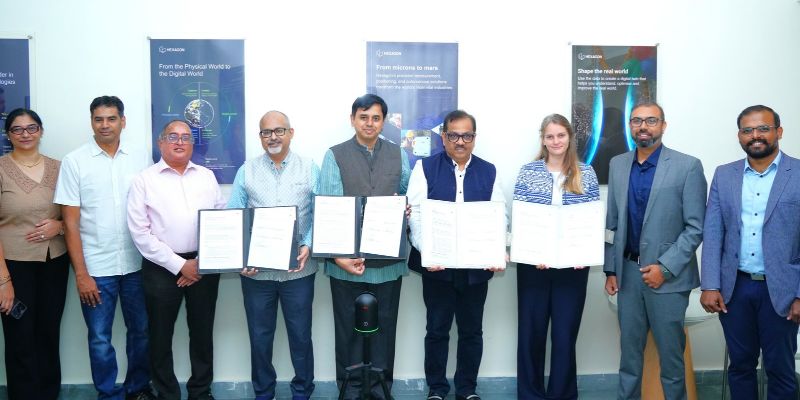
IIIT Hyderabad, Hexagon Set Up Digital Twin Centre of Excellence
IIIT Hyderabad and Hexagon R&D India are establishing a Digital Twin CoE to advance AI-led research, education and industry applications in computer vision and spatial computing.
Read moreSmart Manufacturing
The factory of tomorrow is drawn on today's engineering desk
India’s manufacturing future will depend on integrating product engineering, digital tools and factory design to build smarter, flexible operations, writes Kamakshya Prasad Prusti, VP, Integrated ..
Read moreRelated Products

Fanless Industrial Pc for Smart Manufacturing
Smart Manufacturing
CONTEC Launches BX-M4600 Series - Fanless Industrial PC for Smart Manufacturing.
latest News
Subscribe to iNoW

For Industry News on WhatsApp, Give a Miss Call on: +91 84228 74016